


Table Of Contents
Add a header to begin generating the table of contents

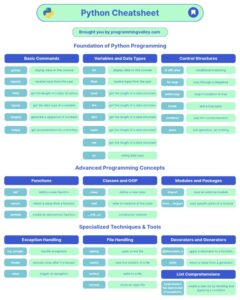
Python is a versatile language used for everything from automation to AI. This cheatsheet gives you a fast overview of essential syntax and tools across all levels.
📖 Foundation of Python Programming
Basic Commands
print()– Show output on the screeninput()– Get user inputlen()– Count items in a structuretype()– Check variable typerange()– Generate a sequence of numbershelp()– Get built-in documentation
Variables and Data Types
int,float,bool– Numeric and logical valuesstr– Text datalist– Ordered, changeable collectiontuple– Ordered, unchangeable collectiondict– Key-value mappingset– Unordered, unique values
Control Structures
if,elif,else– Conditional logicfor– Iterate over a sequencewhile– Loop based on conditionbreak– Stop loop earlycontinue– Skip iterationpass– Do nothing (placeholder)
🧑💻 Advanced Programming Concepts
Functions
def– Create a functionreturn– Send back a resultlambda– Short anonymous function
Object-Oriented Programming (OOP)
class– Define an object templateself– Reference the current object__init__()– Constructor method
Modules and Packages
import– Load a modulefrom ... import– Import specific items
🛠️ Specialized Techniques & Tools
Exception Handling
try,except– Catch errorsfinally– Always execute after tryraise– Create custom exceptions
File Handling
open()– Access filesread(),write()– Read or write file contentclose()– Close file connection
Decorators and Generators
@decorator_name– Modify function behavioryield– Return a value from a generator
List Comprehensions
[x for x in list if condition]– Build lists in one line
Use this cheatsheet to review, refresh, or onboard faster.
Want more Python deep dives?
Explore free Python courses at programmingvalley.com


No Comments