


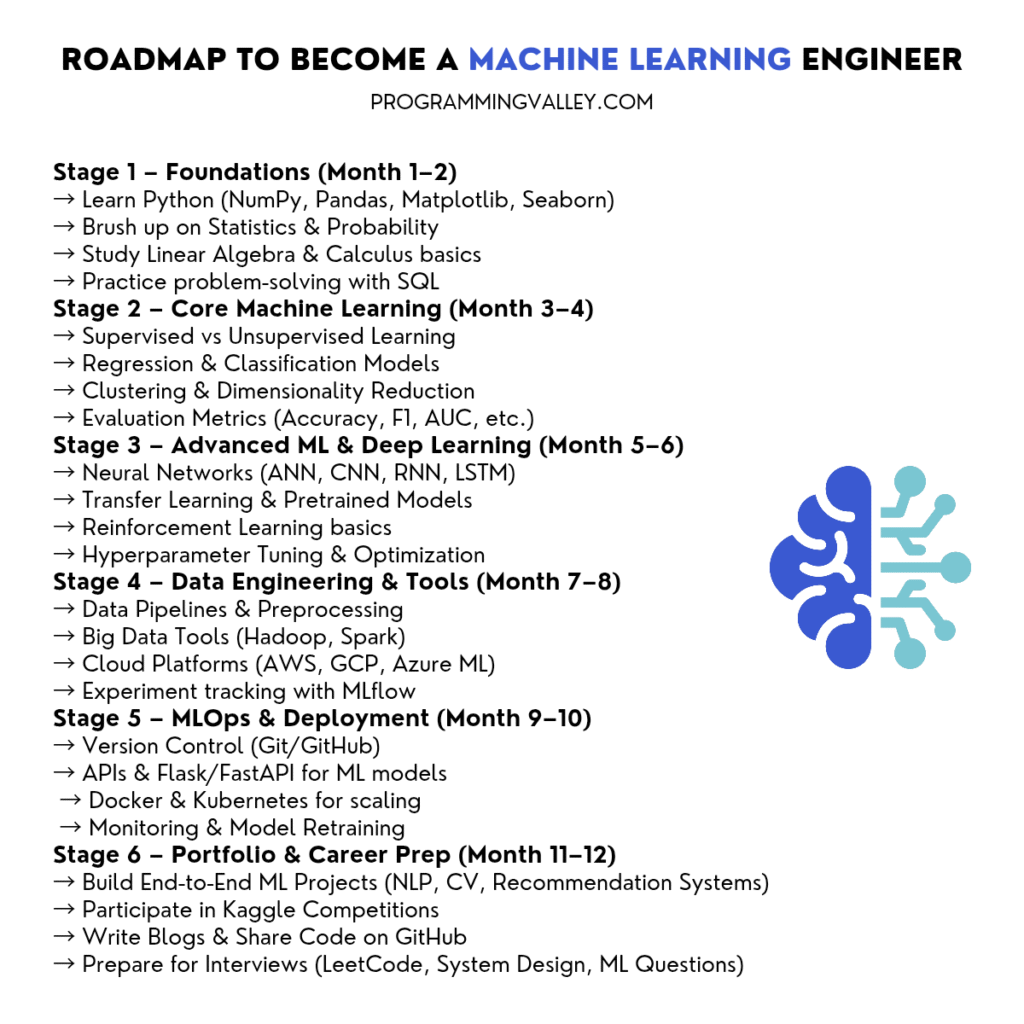
- Stage 1 – Foundations (Month 1–2)
- Stage 2 – Core Machine Learning (Month 3–4)
- Stage 3 – Advanced ML & Deep Learning (Month 5–6)
- Stage 4 – Data Engineering & Tools (Month 7–8)
- Stage 5 – MLOps & Deployment (Month 9–10)
- Stage 6 – Portfolio & Career Prep (Month 11–12)
- Free Resources to Get Started
- Final Thoughts
Machine Learning (ML) engineering is one of the fastest-growing career paths in tech. From powering recommendation systems at Netflix to building self-driving car models, ML engineers work at the intersection of data, algorithms, and software engineering.
But the path to becoming a Machine Learning Engineer can feel overwhelming. To simplify your journey, here’s a 12-month step-by-step roadmap you can follow.
Stage 1 – Foundations (Month 1–2)
Before diving into machine learning models, you need to build strong fundamentals:
→ Python: Learn libraries like NumPy, Pandas, Matplotlib, Seaborn.
→ Math & Stats: Brush up on statistics, probability, linear algebra, and calculus.
→ SQL: Practice problem-solving with queries, joins, and aggregations.
Stage 2 – Core Machine Learning (Month 3–4)
Start applying theory with practical ML models:
→ Supervised vs. Unsupervised learning.
→ Regression and classification algorithms.
→ Clustering & dimensionality reduction.
→ Evaluation metrics (accuracy, precision, recall, F1-score, AUC).
Stage 3 – Advanced ML & Deep Learning (Month 5–6)
Once you’re comfortable with basics, move into deep learning:
→ Neural Networks (ANN, CNN, RNN, LSTM).
→ Transfer learning & pretrained models.
→ Basics of reinforcement learning.
→ Hyperparameter tuning & optimization.
Stage 4 – Data Engineering & Tools (Month 7–8)
ML isn’t just about algorithms—it’s about handling real-world data:
→ Building data pipelines & preprocessing.
→ Working with big data tools (Hadoop, Spark).
→ Cloud platforms: AWS, GCP, Azure ML.
→ Experiment tracking with MLflow.
Stage 5 – MLOps & Deployment (Month 9–10)
Time to take your models to production:
→ Version control (Git/GitHub).
→ Serving models via APIs (Flask/FastAPI).
→ Docker & Kubernetes for scaling.
→ Monitoring, retraining, and automation.
Stage 6 – Portfolio & Career Prep (Month 11–12)
Your skills are only as strong as your ability to demonstrate them:
→ Build end-to-end ML projects (NLP, CV, recommendation systems).
→ Participate in Kaggle competitions.
→ Share projects on GitHub & write blogs.
→ Prepare for interviews (LeetCode, system design, ML-specific questions).
Free Resources to Get Started
Here are some free courses you can use to master each stage (no certification, pure learning):
- IBM AI Developer Professional Certificate
- Generative AI for Data Scientists
- IBM Data Science
- SQL Basics for Data Science
Final Thoughts
Becoming a Machine Learning Engineer is not about learning everything at once. It’s about structured learning and applying concepts through real projects.
If you follow this roadmap step by step, by the end of 12 months, you’ll have the skills and portfolio to apply for ML Engineer roles with confidence.
💡 Start today, stay consistent, and remember—projects speak louder than resumes.


No Comments