



Whether you’re analyzing data, building machine learning models, or crunching numbers, NumPy is a core part of your Python workflow. This post gives you a fast, practical overview of 40 frequently used NumPy functions and what each one does. You’ll also find clear examples to help you apply them right away.
Array Creation
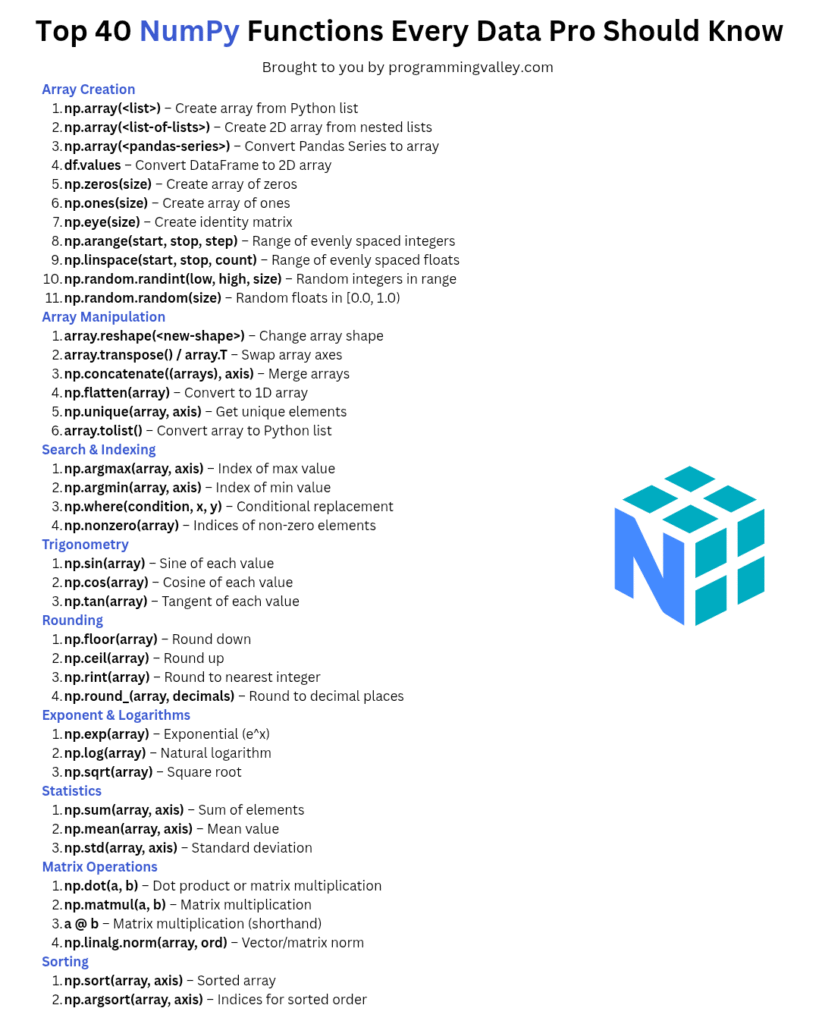
np.array(<list>)– Create array from Python listnp.array(<list-of-lists>)– Create 2D array from nested listsnp.array(<pandas-series>)– Convert Pandas Series to arraydf.values– Convert DataFrame to 2D arraynp.zeros(size)– Create array of zerosnp.ones(size)– Create array of onesnp.eye(size)– Create identity matrixnp.arange(start, stop, step)– Range of evenly spaced integersnp.linspace(start, stop, count)– Range of evenly spaced floatsnp.random.randint(low, high, size)– Random integers in rangenp.random.random(size)– Random floats in [0.0, 1.0)
Array Manipulation
array.reshape(<new-shape>)– Change array shapearray.transpose()/array.T– Swap array axesnp.concatenate((arrays), axis)– Merge arraysnp.flatten(array)– Convert to 1D arraynp.unique(array, axis)– Get unique elementsarray.tolist()– Convert array to Python list
Search & Indexing
np.argmax(array, axis)– Index of max valuenp.argmin(array, axis)– Index of min valuenp.where(condition, x, y)– Conditional replacementnp.nonzero(array)– Indices of non-zero elements
Trigonometry
np.sin(array)– Sine of each valuenp.cos(array)– Cosine of each valuenp.tan(array)– Tangent of each value
Rounding
np.floor(array)– Round downnp.ceil(array)– Round upnp.rint(array)– Round to nearest integernp.round_(array, decimals)– Round to decimal places
Exponent & Logarithms
np.exp(array)– Exponential (e^x)np.log(array)– Natural logarithmnp.sqrt(array)– Square root
Statistics
np.sum(array, axis)– Sum of elementsnp.mean(array, axis)– Mean valuenp.std(array, axis)– Standard deviation
Matrix Operations
np.dot(a, b)– Dot product or matrix multiplicationnp.matmul(a, b)– Matrix multiplicationa @ b– Matrix multiplication (shorthand)np.linalg.norm(array, ord)– Vector/matrix norm
Sorting
np.sort(array, axis)– Sorted arraynp.argsort(array, axis)– Indices for sorted order
Final Thoughts
These functions form the backbone of any serious data work in Python. Mastering them will save time, reduce bugs, and unlock the real power of scientific computing.
Which function do you use most?
What should we cover next—Pandas or Matplotlib?
Share your thoughts in the comments.
🎓 Learn with these top Python + Data Science Courses:
🔗 Google IT Automation with Python → https://imp.i384100.net/c/5617308/2804871/14726
🔗 Microsoft Python Development Certificate → https://imp.i384100.net/c/5617308/2720162/14726
🔗 IBM Data Science Certificate → https://imp.i384100.net/c/5617308/1688120/14726
🔗 SQL for Data Science → https://imp.i384100.net/c/5617308/1688118/14726


No Comments