


AI models are powerful.
But alone, they are limited.
They cannot access real tools, databases, or systems by default.
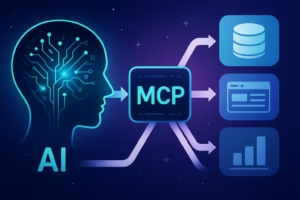
This is where MCP comes in.
What is MCP in AI
MCP stands for Model Context Protocol.
It is a standard that helps AI models connect with tools, data, and external systems.
Think of it as a bridge.
It allows AI to move from just answering questions to actually doing tasks.
Why MCP matters
Without MCP, AI works like this:
- You ask a question
- The model responds based on training data
With MCP, AI works like this:
- Receives a request
- Chooses the right tool
- Calls APIs or databases
- Processes real data
- Returns a useful result
This changes everything.
Simple example
Without MCP
You ask: What is my latest order
The AI guesses or fails.
With MCP
The AI:
- Calls your database API
- Fetches real order data
- Returns accurate answer
How MCP works
MCP defines how AI communicates with tools.
It standardizes:
- Inputs
- Outputs
- Tool descriptions
- Execution flow
This removes guesswork.
It makes integrations predictable.
Core components of MCP
1. Model
The AI that understands the request and decides what to do
2. Context
The data available to the model including memory, inputs, and tools
3. Protocol
The rules that define how the model interacts with external systems
MCP vs API
Many people confuse MCP with APIs.
They are not the same.
| API | MCP |
|---|---|
| Connects systems | Connects AI to systems |
| Static usage | Dynamic decision making |
| Developer controls logic | AI chooses what to call |
Where MCP is used
- AI agents
- Automation tools like n8n
- Chatbots with real actions
- Developer assistants
- Enterprise AI systems
Real use cases
Customer support
AI reads ticket → calls CRM → responds with real data
Data analysis
AI queries database → processes results → returns insights
Dev workflows
AI reads repo → runs commands → fixes issues
Automation
AI triggers workflows across multiple tools
MCP and AI agents
MCP is the backbone of modern AI agents.
Without it, agents cannot act.
With it, agents can:
- Use tools
- Chain actions
- Store memory
- Make decisions
This is what turns AI into a system, not just a chatbot.
Why developers care
MCP reduces complexity.
- No need to hardcode every integration
- Reusable tool definitions
- Cleaner architecture
- Faster development
You focus on logic.
The protocol handles communication.
Common mistakes
- Thinking MCP replaces APIs
- Using AI without real tool access
- Ignoring context design
- Not handling failures in tool calls
Avoid these early.
When you should use MCP
- Building AI agents
- Automating workflows
- Connecting AI to databases
- Creating smart assistants
When you do not need MCP
- Simple chatbots
- Static Q&A systems
- Content generation only
Final thoughts
MCP is a key shift in AI.
It moves AI from thinking to doing.
If you plan to build real AI systems, you will use it.
Start simple.
Connect one tool.
Then expand.
FAQ
What does MCP stand for in AI
Model Context Protocol
Is MCP required for AI agents
Yes for advanced agents that interact with tools and systems
Is MCP the same as API
No MCP is a layer that helps AI decide how to use APIs
Can beginners use MCP
Yes especially when using tools like n8n or agent frameworks


No Comments