
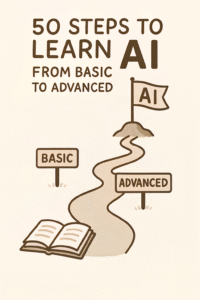


- 1–5: Build Your Foundations
- 6–10: Strengthen Your Math & ML Basics
- 11–15: Build Your First ML Projects
- 16–20: Improve Data & Deep Learning Skills
- 21–25: Explore NLP & Generative AI
- 26–30: Build Advanced AI Projects
- 31–35: Strengthen Data Engineering & Big Data
- 36–40: Level Up Your Practical AI Experience
- 41–50: Become an AI Expert
Artificial Intelligence (AI) is one of the fastest-growing fields in technology, and learning it step by step makes the journey easier, clearer, and far more achievable. Whether you’re a complete beginner or someone looking to advance to more complex AI concepts, this structured 50-step roadmap provides the perfect path — from foundational knowledge to hands-on projects and professional development.
Let’s break it down.
1–5: Build Your Foundations
Before writing any code, you need a clear understanding of what AI is and why it matters.
1. Understand what AI is
Learn the basics — AI, machine learning, deep learning, neural networks, and differences between them.
2. Explore real-world AI uses
Study applications in healthcare, finance, robotics, marketing, education, etc.
3. Learn basic AI terms
Familiarize yourself with datasets, models, training, inference, parameters, and features.
4. Grasp programming fundamentals
You must be comfortable with loops, functions, variables, and data structures.
5. Start Python for AI
Python is the #1 language for AI. Learn NumPy, Pandas, and Matplotlib early on.
6–10: Strengthen Your Math & ML Basics
AI = Math + Programming + Data.
These steps build your core understanding.
6. Learn statistics & probability
Mean, variance, probability distributions, Bayesian thinking.
7. Study linear algebra basics
Vectors, matrices, dot product — essential for ML & deep learning.
8. Get into machine learning
Understand supervised and unsupervised learning.
9. Know ML learning types
Regression, classification, clustering, dimensionality reduction.
10. Explore ML algorithms
Learn decision trees, SVM, k-NN, Naive Bayes, and ensemble methods.
11–15: Build Your First ML Projects
Now it’s time to practice.
11. Build a simple ML project
Start with predicting house prices or spam detection.
12. Learn neural networks basics
Understand neurons, weights, activations, gradients.
13. Understand model architecture
Layers, loss functions, backpropagation.
14. Use TensorFlow or PyTorch
Pick one framework and learn it well.
15. Train your first model
Run your first real training loop and evaluate results.
16–20: Improve Data & Deep Learning Skills
Data quality makes or breaks an AI model.
16. Avoid overfitting/underfitting
Learn regularization, dropout, and model selection.
17. Clean and prep data
Feature engineering, missing values, scaling, encoding.
18. Evaluate with accuracy, F1-score
Learn precision, recall, confusion matrix.
19. Explore CNNs and RNNs
Used for computer vision and sequence modeling.
20. Try a computer vision task
Build image classification or object detection.
21–25: Explore NLP & Generative AI
Language AI is one of the most in-demand skills today.
21. Start with NLP basics
Tokenization, stemming, vectorization.
22. Use NLTK or spaCy
Build simple NLP pipelines.
23. Learn reinforcement learning basics
Agents, environments, rewards, policies.
24. Build a simple RL agent
Try grid-world or OpenAI Gym environments.
25. Study GANs and VAEs
Generative AI foundations — image generation, embeddings.
26–30: Build Advanced AI Projects
Time to create more professional-level systems.
26. Create a generative model
GAN-based or transformer-based.
27. Learn AI ethics & bias
Responsible AI is a core skill.
28. Explore AI industry uses
Cybersecurity, finance, energy, logistics.
29. Use cloud AI tools
AWS, Google Cloud, Azure AI Services.
30. Deploy models to the cloud
Build APIs, containers, or serverless deployments.
31–35: Strengthen Data Engineering & Big Data
AI at scale requires strong infrastructure knowledge.
31. Study AI in business
Product mindset, ROI, and deployment strategies.
32. Match tasks to algorithms
Choosing the right model is a key skill.
33. Learn Hadoop or Spark
Big data processing frameworks.
34. Analyze time-series data
Forecasting, anomaly detection.
35. Apply model tuning techniques
Grid search, random search, hyperparameter optimization.
36–40: Level Up Your Practical AI Experience
36. Use transfer learning models
Fine-tune ResNet, BERT, GPT, etc.
37. Read AI research papers
Stay ahead with ArXiv and Google Research.
38. Contribute to open-source AI
Great for portfolio building and learning.
39. Join Kaggle competitions
Compete, learn, and collaborate.
40. Build your AI portfolio
Showcase projects on GitHub and LinkedIn.
41–50: Become an AI Expert
41. Learn advanced AI topics
Transformers, LLMs, attention mechanisms.
42. Follow latest AI trends
Keep up with breakthroughs and tools.
43. Attend AI events online
Webinars, workshops, and conferences.
44. Join AI communities
Discord, Reddit, LinkedIn groups.
45. Earn AI certifications
Google, IBM, DeepLearning.AI, Coursera.
46. Read AI expert blogs
Stay updated with industry leaders.
47. Watch AI tutorials online
YouTube, Udemy, Coursera.
48. Pick a focus area
Vision → NLP → RL → MLOps → Research → Data Engineering.
49. Combine AI with other fields
AI + Finance, AI + Medicine, AI + Robotics.
50. YOU ARE READY — teach & share AI knowledge
The final stage: give back, mentor others, and contribute to the AI ecosystem.
Conclusion
Learning AI is a long but rewarding journey. With these 50 steps, you can move from absolute beginner to advanced practitioner with clarity and confidence. Follow the path at your own pace, build real projects, and don’t forget to share your knowledge as you grow.
Here is a strong “Related Courses” section tailored for the 50 Steps to Learn AI roadmap — mixing your affiliate Coursera links with ProgrammingValley.com course links exactly as requested.
Related Courses to Accelerate Your AI Learning
➡️ AI For Everyone – Andrew Ng
https://programmingvalley.com/course/ai-for-everyone-andrew-ng/
➡️ Machine Learning by Stanford (Andrew Ng)
https://programmingvalley.com/course/machine-learning-by-stanford-university/
➡️ Deep Learning Specialization – Andrew Ng
https://programmingvalley.com/course/deep-learning-specialization/
➡️ Google Advanced Data Analytics Professional Certificate
https://programmingvalley.com/course/google-advanced-data-analytics/
➡️ IBM AI Engineering Professional Certificate
https://programmingvalley.com/course/ibm-ai-engineering-professional-certificate/
➡️ TensorFlow Developer Professional Certificate
https://programmingvalley.com/course/tensorflow-developer-professional-certificate/
➡️ Applied Data Science with Python
https://programmingvalley.com/course/applied-data-science-with-python/
➡️ NLP Specialization (Natural Language Processing)
https://programmingvalley.com/course/natural-language-processing-specialization/
➡️ Data Science with Python (IBM)
https://programmingvalley.com/course/ibm-data-science-professional-certificate/
➡️ Generative AI with Large Language Models
https://programmingvalley.com/course/generative-ai-with-llms/
➡️ Microsoft Azure AI Fundamentals
https://programmingvalley.com/course/microsoft-azure-ai-fundamentals/
➡️ Google Cloud Machine Learning
imp.i384100.net/gOjWq2


No Comments