


- Quick Summary
- What a Data Scientist Does
- Step 1: Learn Python
- Step 2: Learn SQL
- Step 3: Learn Statistics and Probability
- Step 4: Learn Machine Learning Fundamentals
- Step 5: Use a Structured Certificate
- Step 7: Learn to Explain Your Work
- Step 8: Choose the Right Entry Point
- Step 9: Prepare for Interviews
- 6-Month Data Scientist Roadmap
- Common Mistakes
- Final Recommendation
Data science is still one of the highest-paying paths in tech.
But it is not a shortcut career.
You need the right skills, the right projects, and a clear roadmap.
This guide shows you how to become a data scientist in 2026 step by step.
Quick Summary
- Learn Python, SQL, and statistics first.
- Build machine learning projects with real datasets.
- Create a portfolio that proves your skills.
- Use one structured certificate to stay on track.
- Apply for analyst, junior data science, or ML-related roles.
What a Data Scientist Does
A data scientist uses data to solve business problems and build predictive models.
Common work includes:
- Cleaning and analyzing large datasets
- Building machine learning models
- Testing features and experiments
- Finding patterns and making forecasts
- Explaining results to business teams
Step 1: Learn Python
Python is the main language for data science.
Focus on:
- Variables, loops, functions
- Pandas
- NumPy
- Matplotlib
- Jupyter notebooks
You do not need advanced software engineering first. You need practical Python for analysis.
Step 2: Learn SQL
SQL is required in most data roles.
Focus on:
- SELECT and filtering
- JOINs
- GROUP BY
- Subqueries
- Window functions basics
If you have not learned SQL yet, start here:
Start SQL Basics for Data Science
Step 3: Learn Statistics and Probability
This is where many beginners struggle.
You do not need to become a mathematician.
But you do need a strong base in:
- Mean, median, variance, standard deviation
- Probability basics
- Distributions
- Hypothesis testing
- Correlation and regression
Step 4: Learn Machine Learning Fundamentals
Machine learning is the core technical layer of data science.
Focus on:
- Supervised learning
- Unsupervised learning
- Train and test split
- Model evaluation metrics
- Overfitting and underfitting
Best place to start:
Step 5: Use a Structured Certificate
A certificate helps you stay focused and build projects in the right order.
Best starting option:
Start IBM Data Science Certificate
This is a strong choice because it includes Python, SQL, visualization, and machine learning basics.
You can also browse more paths here:
Browse Coursera Data Science Courses
Step 6: Build a Data Science Portfolio
You need proof of work.
Build at least 4 projects.
Project 1: Exploratory Data Analysis
- Choose a public dataset
- Clean it
- Find patterns
- Write insights
Project 2: Classification Model
- Predict yes or no outcome
- Use logistic regression or tree-based model
- Show accuracy, precision, recall
Project 3: Regression Model
- Predict a numeric value
- Compare two models
- Explain error metrics
Project 4: End-to-End Case Study
- Data collection or public dataset
- Cleaning
- Visualization
- Modeling
- Business recommendation
Publish everything on GitHub.
Step 7: Learn to Explain Your Work
Technical skill alone is not enough.
You must explain:
- Why you chose the dataset
- Why you selected the model
- What metrics you used
- What business value your result creates
This helps in interviews more than most people expect.
Step 8: Choose the Right Entry Point
You do not always need your first title to be Data Scientist.
Many people enter through:
- Data Analyst
- Business Analyst
- Junior Data Scientist
- Machine Learning Intern
- Analytics Engineer
If you want a faster entry path, also read:
How to Become a Data Analyst in 2026
Step 9: Prepare for Interviews
Data science interviews often test:
- Python
- SQL
- Statistics
- Machine learning theory
- Case study thinking
Practice by explaining your own projects out loud.
6-Month Data Scientist Roadmap
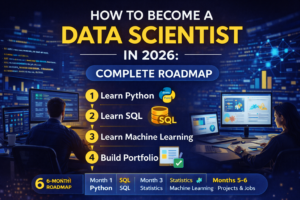
- Month 1: Python fundamentals
- Month 2: SQL and data analysis
- Month 3: Statistics and probability
- Month 4: Machine learning basics
- Month 5: Portfolio projects
- Month 6: Resume, interview prep, applications
Common Mistakes
- Trying to learn too many tools at once
- Watching videos without building projects
- Skipping statistics
- Not publishing work publicly
- Applying too late
Final Recommendation
Start with Python, SQL, and statistics.
Then move into machine learning.
Build strong projects.
Show your work publicly.
Best places to start:



No Comments