


- What Is Data Science?
- Is Data Science a Good Career in 2026?
- What Skills Do Beginners Need First?
- Step 1: Learn Python
- Step 2: Learn SQL
- Step 3: Learn Basic Statistics
- Step 4: Learn Data Visualization
- Step 5: Understand Machine Learning Basics
- What Should Beginners Learn First?
- How Long Does It Take to Learn Data Science?
- What Projects Should Beginners Build?
- Common Beginner Mistakes
- Should You Start with Data Analyst or Data Scientist?
- Final Recommendation
Data science looks hard from the outside.
Python. SQL. statistics. machine learning. dashboards. projects.
That is why many beginners feel lost before they even start.
The truth is simple.
You do not need to learn everything at once.
You need the right order.
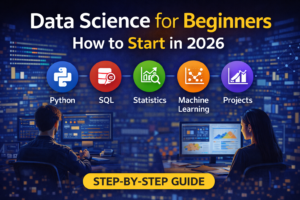
This guide shows you exactly how to start data science in 2026 as a beginner, what skills matter most, and which learning path makes sense.
What Is Data Science?
Data science is the process of using data to find patterns, answer questions, and make predictions.
It combines:
- Data analysis
- Programming
- Statistics
- Machine learning
- Business thinking
In simple terms, data science helps companies make better decisions using data.
Is Data Science a Good Career in 2026?
Yes.
Data science remains one of the strongest career paths for people who enjoy analysis, problem solving, and working with technology.
It is not an easy field, but it still offers:
- Strong salaries
- Remote opportunities
- Career growth
- Transferable skills across industries
If you are wondering whether the market is too crowded, read this next:
Is Data Science Oversaturated in 2026?
What Skills Do Beginners Need First?
Start with the foundations.
Not advanced deep learning.
Not complicated math proofs.
Start here:
- Python
- SQL
- Basic statistics
- Data cleaning
- Data visualization
Step 1: Learn Python
Python is the main language used in data science.
You will use it for cleaning data, analysis, and machine learning.
Focus on:
- Variables and data types
- Loops and functions
- Pandas
- NumPy
- Jupyter notebooks
You do not need to become a software engineer first. You just need practical Python for data work.
Step 2: Learn SQL
SQL is essential.
Most real data jobs require it.
Start here:
Focus on:
- SELECT and filtering
- ORDER BY
- JOINs
- GROUP BY
- Subqueries
If you want a deeper SQL path, also read:
Best SQL Courses for Beginners in 2026
Step 3: Learn Basic Statistics
You need enough statistics to understand data and interpret results.
Start with:
- Mean and median
- Standard deviation
- Probability basics
- Distributions
- Correlation
- Hypothesis testing
You do not need advanced math at the start. You need clear understanding of the basics.
Step 4: Learn Data Visualization
Charts and dashboards help you explain insights clearly.
Beginners should learn how to present data, not just analyze it.
Useful tools:
- Matplotlib
- Seaborn
- Tableau
- Power BI
Step 5: Understand Machine Learning Basics
You do not need to start here, but you should reach it after Python, SQL, and statistics.
Focus on the basics first:
- Supervised learning
- Unsupervised learning
- Train and test split
- Model evaluation
- Overfitting and underfitting
Good starting point:
Best Courses for Beginners
If you want structure, these are strong starting points.
1. Google Data Analytics Certificate
Best for beginners who want to start with analytics, reporting, and business data skills.
Start Google Data Analytics Certificate
2. IBM Data Science Certificate
Best for beginners who want a broader technical path into data science.
Start IBM Data Science Certificate
3. Coursera Data Science Courses
Good if you want to explore several paths and compare options.
Browse Coursera Data Science Courses
What Should Beginners Learn First?
Use this order:
- Python basics
- SQL
- Statistics fundamentals
- Data cleaning and analysis
- Visualization
- Machine learning basics
This order is much better than jumping straight into AI hype content.
How Long Does It Take to Learn Data Science?
That depends on your pace.
A realistic beginner path looks like this:
- 1 to 2 months for Python and SQL basics
- 1 month for statistics and visualization
- 1 to 2 months for projects and machine learning basics
In other words, you can build a solid beginner foundation in 3 to 6 months with consistency.
What Projects Should Beginners Build?
Projects are what make you stand out.
Start simple.
- Sales analysis dashboard
- Customer churn analysis
- SQL case study on a public dataset
- Simple prediction model using regression or classification
Publish your work on GitHub and write short project summaries.
Common Beginner Mistakes
- Trying to learn everything at once
- Skipping SQL
- Watching videos without practice
- Focusing only on certificates
- Not building projects
Should You Start with Data Analyst or Data Scientist?
For many beginners, data analyst is the easier entry point.
It helps you build practical data skills before moving deeper into data science.
Read these next:
- How to Become a Data Analyst in 2026
- How to Become a Data Scientist in 2026
- Data Analyst vs Data Scientist
Final Recommendation
If you are a beginner, do not overcomplicate the journey.
Start with one structured path.
Learn Python and SQL first.
Build projects as you go.
Then move into machine learning.
Best places to start:


No Comments