


Introduction
Machine Learning is one of the most in-demand skills in the world today. But for many learners, the biggest challenge isn’t motivation—it’s direction.
Andrew Ng’s Machine Learning Specialization on Coursera provides one of the most structured, beginner-friendly paths to becoming a Machine Learning Engineer or Data Scientist.
This post breaks down the course into a six-stage roadmap that takes you from zero to advanced concepts — with practical projects, mathematics, and model deployment.
Start learning here → https://imp.i384100.net/7aqNGY
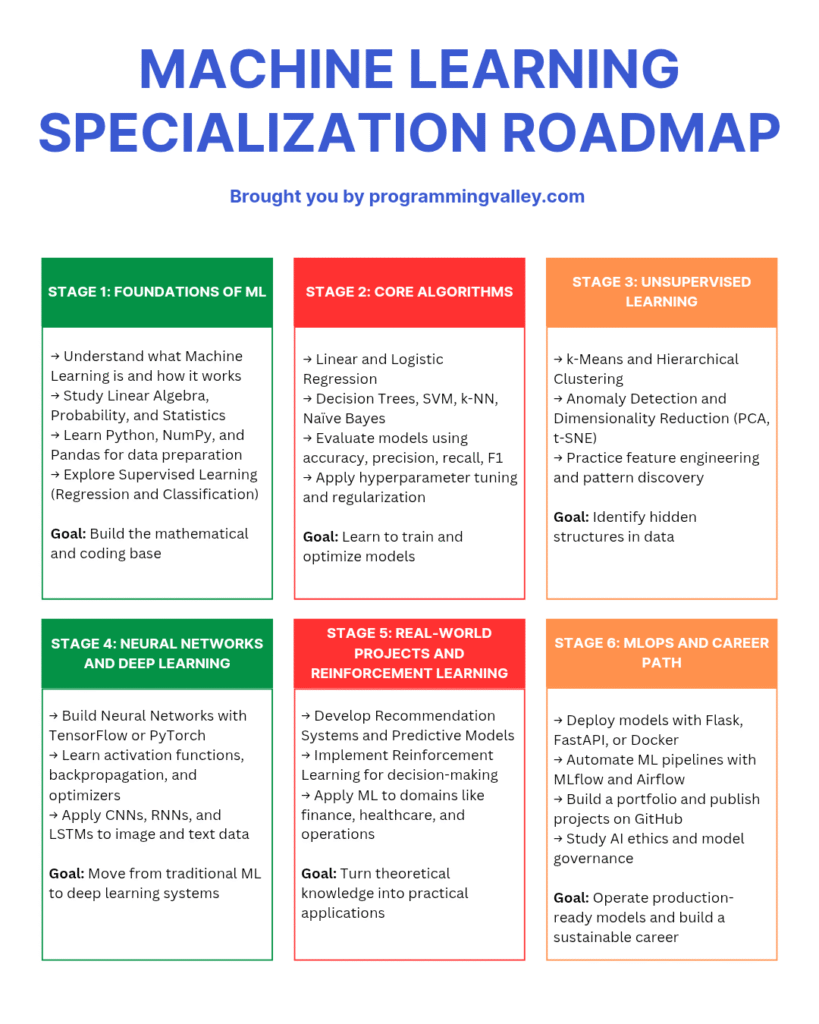
Stage 1: Foundations of Machine Learning
Before writing your first algorithm, you need to understand the fundamentals.
This stage covers:
- What Machine Learning is and how it differs from traditional programming
- Core math foundations — Linear Algebra, Probability, and Statistics
- Python essentials using NumPy and Pandas
- Introduction to Supervised Learning (Regression and Classification)
By the end of this stage, you’ll understand how data becomes insight — the foundation for all ML work.
Stage 2: Core Algorithms
Now you’ll move from theory to implementation.
In this part, you’ll master:
- Linear and Logistic Regression
- Decision Trees, SVM, k-NN, and Naïve Bayes
- Evaluation metrics (accuracy, precision, recall, F1-score)
- Regularization and hyperparameter tuning
You’ll gain a deeper understanding of how algorithms make predictions and how to improve their accuracy.
Stage 3: Unsupervised Learning
Not all data comes with labels.
This stage introduces techniques to find structure in unlabeled data, including:
- Clustering (k-Means, Hierarchical Clustering)
- Dimensionality Reduction (PCA, t-SNE)
- Anomaly Detection and pattern recognition
These concepts are crucial for feature extraction, recommendation systems, and exploratory data analysis.
Stage 4: Neural Networks and Deep Learning
Once you understand classic algorithms, it’s time to explore the deep side of ML.
In this stage, you’ll learn:
- How Neural Networks work
- Activation functions, backpropagation, and optimization
- Building CNNs, RNNs, and LSTMs for image and text data
You’ll use frameworks like TensorFlow and PyTorch to train real deep learning models.
Stage 5: Real-World Projects and Reinforcement Learning
Machine Learning becomes meaningful when applied to real problems.
In this phase, you’ll:
- Build predictive models and recommendation systems
- Apply ML to domains like finance, healthcare, and marketing
- Learn the basics of Reinforcement Learning and intelligent agents
This is where theory meets industry applications.
Stage 6: MLOps and Career Path
Learning doesn’t stop once you build a model — you must deploy and maintain it.
This final stage focuses on:
- Model deployment with Flask, FastAPI, and Docker
- Automating ML pipelines with MLflow and Airflow
- Portfolio building and version control with GitHub
- Understanding AI ethics and model governance
By this point, you’ll have a complete end-to-end understanding of how to build, evaluate, and deploy machine learning systems.
Why Learn from Andrew Ng?
Andrew Ng is one of the pioneers of modern AI education.
His teaching style combines simplicity with depth — making even complex concepts approachable.
The Machine Learning Specialization by DeepLearning.AI and Stanford University is one of Coursera’s highest-rated programs, trusted by millions of learners worldwide.
Start the specialization today → https://imp.i384100.net/7aqNGY
Conclusion
Machine Learning is a skill that opens doors — to research, AI startups, data-driven companies, and beyond.
This six-stage roadmap gives you a clear direction: from mathematical foundations to model deployment.
Whether you’re a student, software developer, or career switcher, this course is the perfect place to begin.
Start your ML journey now → https://imp.i384100.net/7aqNGY


No Comments